
Key themes shaping the future of digital infrastructure
Nine reflections from MWC26
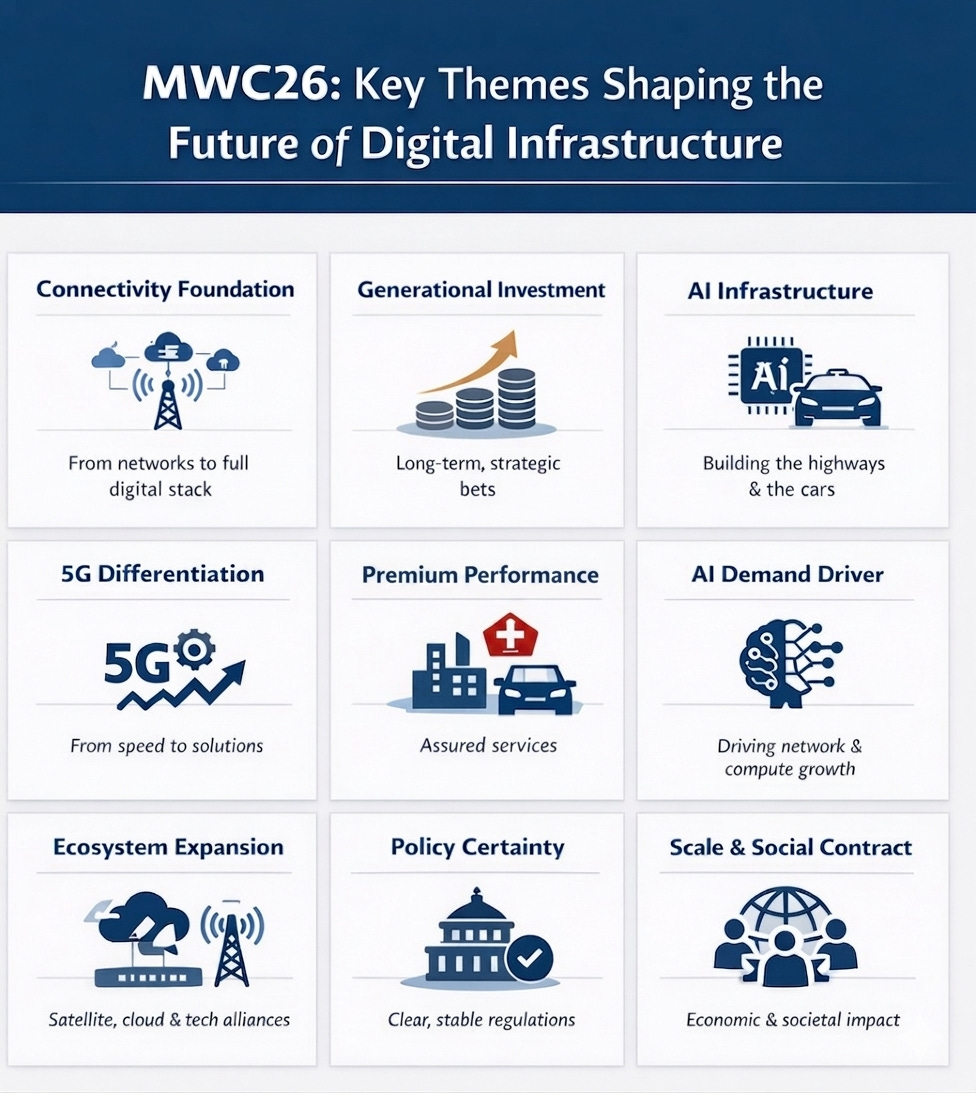
Connectivity Foundation
Connectivity remains the backbone of the digital economy — but it is now part of a broader, interdependent digital infrastructure stack that includes cloud, data centres, financial systems and AI. The integrity of this digital infrastructure stack is fast becoming a competitive differentiator and a source of strategic risk. AT&T’s $250 Billion, five year. connectivity investment commitment (announced in March 2026) is a clear indication of the importance of a unified connectivity fabric and its positioning as a critical element of the digital infrastructure stack.Generational Bets
Operators, tech companies and governments are making long-term investment bets in infrastructure while balancing these bets with capital discipline, returns and societal value. Analyst projections indicate a cooling of telecoms infrastructure capex intensity and a parallel accelerating AI supercycle capex with surging capex intensity of hyperscalars. Capital is being reprioritised as companies and countries navigate these investment bets.AI Infrastructure
Firms are building both the highways (compute and connectivity infrastructure) and the cars (AI applications and services). This metaphor is becoming important with firms owning both layers being better placed to co-optimise the infrastructure-software stack and capture disproportionate value.5G Differentiation
5G is gradually evolving from “best effort” connectivity to differentiated, outcome-based services. This addresses the initial 5G monetisation gap facing the industry. Enhanced mobile broadband speeds alone did not deliver the returns on the 5G investments. With the arrival of 5G-Standalone networks and network APIs, operators are beginning to offer not just GBytes based pricing but also value-based pricing.Premium Performance
Real-world use cases in enterprises, mobility and healthcare are showing signs of willingness to pay for assured performance and reliability — if these capabilities can scale. This shifts the performance guarantee conversation from "best-effort-plus" toward “mission-critical SLAs.” The challenge is to build the commercial and delivery architecture to productise premium performance at the scale and granularity that these use cases demand.AI Demand Driver
For operators, AI is both an efficiency lever and a demand engine, improving operations while creating new workloads that require connectivity and compute resources. Nine out of ten respondents to NVIDIA's 2026 State of AI in Telecommunications survey reported that AI has a positive impact on revenues and costs - highlighting this dual role.Ecosystem Expansion
Satellite-to-mobile and cloud partnerships are becoming important complements to traditional operator capabilities. Ecosystem expansion acknowledges that no entity can build the entire digital stack alone. Amazon's $11.6 billion acquisition of Globalstar — announced on 14 April 2026 - is emblematic of this shift towards an “integrated stack” .Policy Certainty
Regulatory clarity, government partnerships and long-term policy direction are increasingly prerequisites for large-scale infrastructure investment. The global regulatory direction has shifted from competition maximisation toward frameworks that prioritise digital infrastructure competitiveness. The European Commission proposed (in January 2026) the Digital Networks Act (DNA) to “modernise, simplify and harmonise EU rules on connectivity networks” recognising that advanced connectivity is the foundation of competitiveness.Scale Imperative
Scale matters — not just commercially, but in aligning digital infrastructure investment with broader socio-economic goals. Digital infrastructure economics are built on high fixed costs, network effects, and massive resource requirements. Scale is a valuable resource for an infrastructure firm; the strategic moves of 2026 - market repair, connectivity convergence, spectrum acquisition and asset rationalisation - are all expressions of the scale imperative.
The nine themes ultimately point to one strategic reality - digital infrastructure is becoming a deeply interdependent, capital-intensive system where advantage accrues to those who can integrate, scale, and orchestrate across the full stack.